
Context: For the ongoing cross-licensing dispute between ZTE (net licensor) and Samsung (net licensee), which resolve disputed back-royalties not only from January 1, 2024 (the day after the previous contract expired) but also for certain types of use in the years before,
- the Chongqing Intermediate People’s Court determined that a balancing payment of $731M for a contract term until the end of 2029 was fair, reasonable, and non-discriminatory (FRAND) (May 11, 2026 ip fray article with English translation of judgment and detailed analysis);
- the Munich I Regional Court held that ZTE could have demanded up to $798.6M from Samsung and proposed a $640M settlement for a contract term until the end of 2028 (May 6, 2026 ip fray article);
- the Frankfurt Regional Court did not take issue with ZTE’s position, but held that the terms on which Samsung sought to obtain a license were not clearly the upper end of the FRAND range (February 25, 2026 ip fray article);
- the appeals court of the Rio de Janeiro State Judiciary effectively also blessed ZTE’s position on FRAND (February 4, 2026 ip fray article); and
- the High Court of Justice for England and Wales (EWHC) is the outlier with a $392M rate-setting decision (May 1, 2026 ip fray article).
What’s new:
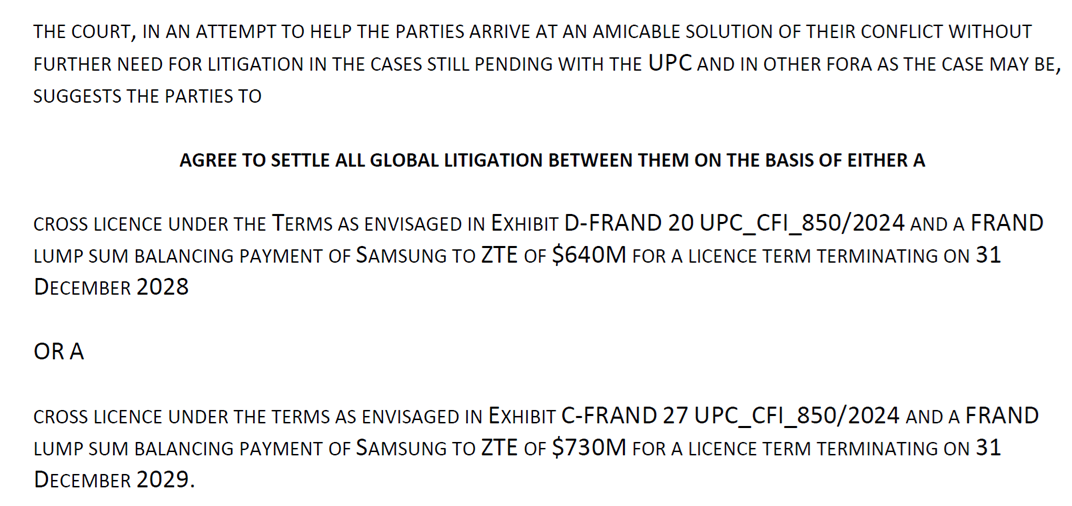
- In an order bearing tomorrow’s date (May 13, 2026), but already signed by all judges on Friday (May 8, 2026), the UPC’s Mannheim Local Division (LD) made a settlement proposal that is materially consistent with both the Chinese and German determinations: $640M for a license until the end of 2028, and $730M for a license until the end of 2029.
- Not only does the court propose monetary amounts, but it specifically references contract language that one of the parties filed with the UPC. The numbers could simply be inserted into those templates, enabling the parties to sign.
- Should the parties not be able to agree on either of those potential terms, the UPC proposes mediation under the auspices of the UPC’s Patent Mediation and Arbitration Centre (PMAC), leading to a stay of the ongoing proceedings and entailing the possibility of the UPC’s Mannheim LD confirming the settlement, thereby making it court-enforceable.
- The parties are requested to respond until May 31, 2026.
Direct impact: This unsolicited suggestion is obviously not binding in any way, but
- it provides the parties with valuable further guidance that could inform company-internal decision-making processes;
- it reveals, in particular, what position on FRAND the panel would likely have taken if it had had the opportunity to adjudicate Samsung’s FRAND counterclaim (April 29, 2026 ip fray article);
- it doesn’t prejudge the two cases between the parties for which the Mannheim LD could now schedule a hearing anytime, but it makes it rather unlikely that Samsung could avoid an injunction in the event of a liability finding; and
- the consensus between multiple non-UK courts, which collectively have jurisdiction over two of the world’s three largest economies and five of the largest ten, will have significant persuasive weight everywhere, meaning that Samsung risks more injunctions by declining to sign on those consensus terms.
Wider ramifications:
- The UPC’s position will be taken note of by other courts that have to decide on the FRAND valuation questions raised by this dispute. The next decision will likely be made by the Munich Higher Regional Court (given that Samsung is certain to appeal and to seek an enforcement stay), and Samsung will also want to appeal the Chinese decision. Wherever Samsung appeals now, or where a first determination has to be made, it will find it hard to defend its stance on FRAND given that all other courts than the one in London arrive at consistent numbers.
- This initiative by the UPC, beyond potentially helping the parties come to an agreement now, demonstrates the Mannheim LD’s willingness to tackle standard-essential patent (SEP) valuation questions (which was known in principle, but now it is being showcased in a concrete form).
- It shows potential synergies between UPC litigation and PMAC mediation, even though it is unlikely at this stage that ZTE would want to mediate, given that mediation does not reliably lead to the conclusion of an agreement. The order references Art. 35 of the UPC Agreement (UPCA), Rule 11.1 of the UPC’s Rules of Procedure (Rop), and Article 5(1) of the PMAC’s Mediation Rules.
- There is interjurisdictional friction due to UK judicial imperialism, with a key hearing taking place before the UPC’s Court of Appeal (CoA) later this month in Amazon v. InterDigital. What the consensus between the UPC’s Mannheim LD and courts in China, Brazil, and Germany shows is that the UK judiciary is increasingly isolated on the global stage with its SEP devaluation agenda at first instance.
Here’s the landmark order:
The order does not indicate whether Samsung submitted the UK FRAND ruling tot he UPC or the court obtained it from the UK judiciary’s website, but the court has taken notices of that one as well as the Frankfurt decision (over which it dismissed Samsung’s FRAND counterclaim on jurisdictional grounds). With respect to the Chongqing and Munich decisions, the order references “public media reports”, meaning that those decisions had not been submitted to the UPC by the time the order was signed (May 8, 2026). It is possible that the court took a look at the translation of the Chongqing ruling that we published yesterday, but that would have been after the order had already been signed.
The predating of the order may have different reasons. It could be that the UPC wanted to await the availability of PMAC inormation sessions and mediation proceedings, for which the key date was yesterday.
Court and counsel
Panel: Presiding Judge Prof. Peter Tochtermann, Judge-rapporteur Dirk Boettcher (“Böttcher”), Judge Carine Gillet (Paris, France), and Technically Qualified Judge Klaus Loibner.
Counsel for ZTE: On FRAND, Vossius & Partner’s Dr. Georg Andreas Rauh and Taliens’s Dr. Thomas Lynker (listed in the header of this order) collaborate. The technical merits in some cases are handled by Taliens, and in others by Vossius. The lead patent attorney on the ZTE cases where Vossius handles the technical merits is Dr. Christian Sandweg, and Dr. Thomas Schwarze for EPO proceedings.
Counsel for Samsung: A&O Shearman’s Dr. Jan Ebersohl (defensive case), Rospatt’s Thomas Musmann (listed in the header of this order) and Hetti Hilge (listed in the header of a decision on a stayed case), and Zimmermann & Partner patent attorney Dr. Joel Naegerl (“Nägerl”), who represents Samsung more frequently than any other German legal professional.