
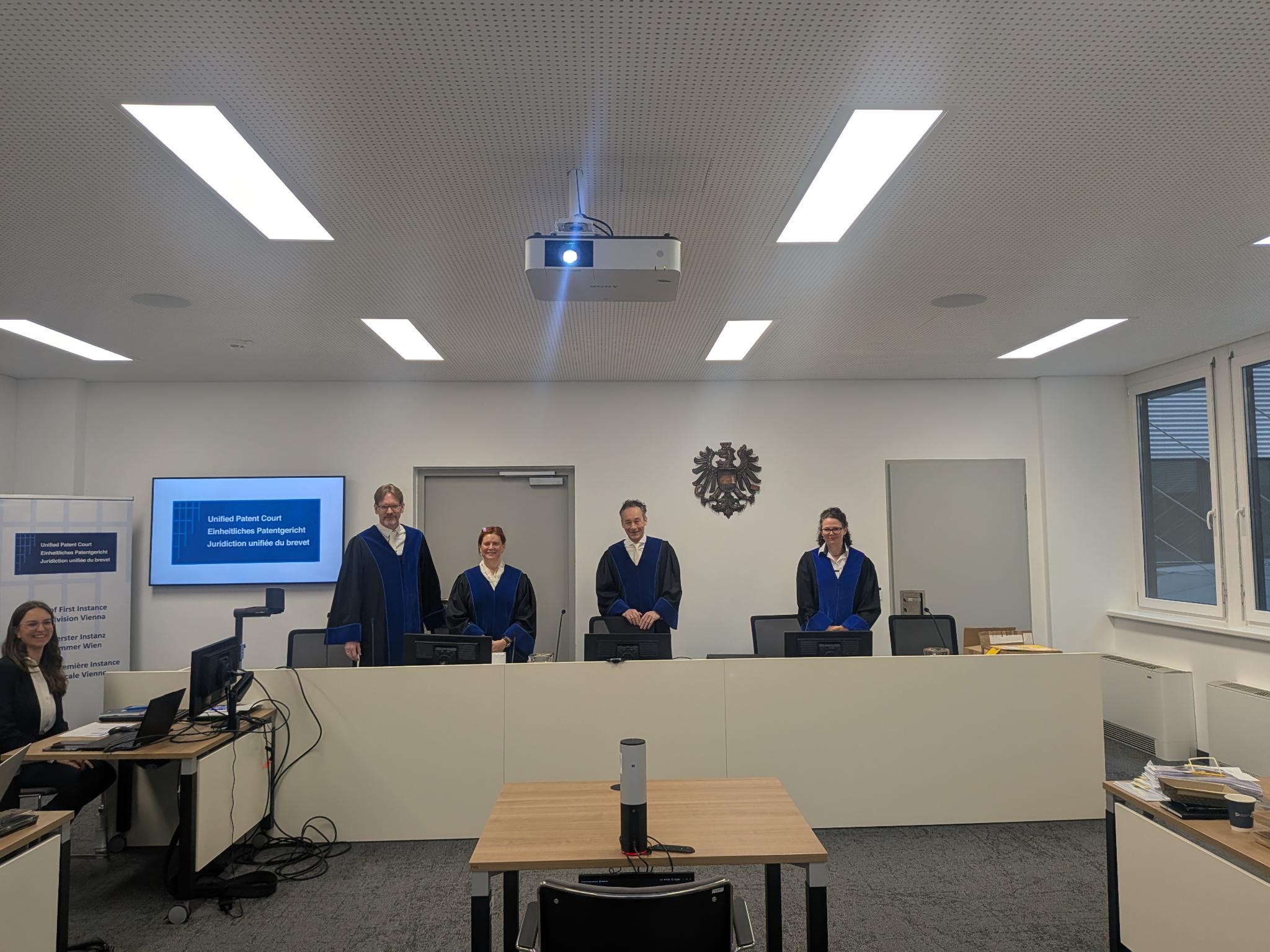
Context:
- Venue and case: We talked about Messerle v. Sabert, an infringement case (with a revocation counterclaim) in the Unified Patent Court’s (UPC) Vienna Local Division (LD) in our report on a settlement in a different case involving different parties further to a Vienna LD injunction (November 28, 2025 ip fray article).
- UPC rules on language of proceedings: Many practitioners express their discontent (largely just in private conversation) with the UPC’s practice of typically switching the language of proceedings from German to English if English is the language of the patent and the defendant is headquartered in a non-German-speaking country. Exceptions such as ParTec v. NVIDIA, where the German claimant is a tiny entity compared to the defendant, are rare (January 17, 2025 ip fray article).
What’s new: Yesterday, the Vienna LD heard Messerle v. Sabert over EP3705415 (“Package, in particular for food products”). The hearing lasted less than four hours (even if breaks are included, and there were several). The court did not schedule a specific date for the ruling, but cited court-internal reasons (one judge’s upcoming vacation) for which the panel would have to decide by February 26, 2026 so as to avoid an excessive delay. The proceedings were very efficient, with the court repeatedly reminding counsel not to reiterate what was already stated in the written pleadings. Presiding Judge Dr. Walter Schober left the technical part of the introductory presentation to Technically Qualified Judge Max Tilmann, whose overview of the claim limitations was very helpful.
Direct impact: The court did not indicate its inclination in the form of a preliminary assessment of the case. There were risks and opportunities for both parties (which is why a settlement was encouraged):
- The defendant had to justify the late presentation of certain invalidity arguments.
- It also became clear that the construction of a German claim term (“ein Knick”, which one might translate as a “crease”, but which the English-language claims call a “fold”) could defeat the infringement allegations. A narrower interpretation according to which a triangle would have to be formed would apparently not be infringed, while a broader one or the doctrine of equivalents (DOE) could lead to an infringement finding. Counsel for Messerle argued that any of the DOE standards used by UPC divisions so far would support an infringement.
- That is probably also the reason why Judge Klein raised the question of whether the defendant would insist on the adjudication of the revocation counterclaim in the event of a finding of no infringement. Counsel for defendant was unable to conditionally waive the counterclaim without consulting the client.
Wider ramifications:
- This was the Vienna LD’s first English-language hearing and may have been the first English-language UPC hearing over a German-language patent (the claims are obviously also available in English and French) in a German-speaking country and even in front of a German-speaking majority (3:1) of judges. If Messerle had filed in German, Sabert could not have sought a switch to English on the grounds of the language of the patent being the more appropriate language of proceedings.
- That may also have to do with the fact that, as counsel for Messerle mentioned, the two parties are generally on good terms and have a vendor-buyer relationship in a different context. This dispute is only about Messerle seeking to enforce exclusivity with respect to a certain type of food packaging where food is placed on a cardboard tray with a preferably transparent plastic lid and where the two parts are connected in a particular way.
Here are some further observations.
Conditional revocation counterclaims could become more popular with UPC judges
The UPC is already fairly popular, and even if a given LD doesn’t have an unbearable case load, the judges themselves are always busy. In a recent Mannheim LD case (Section 4.1 of our December 7, 2025 UPC Roundup), an infringement defendant did not insist on the adjudication of the revocation counterclaim unless it would have been found to infringe. The court gladly saved time that way. There may now be more instances in which UPC judges ask parties whether they are prepared to enter a conditional waiver.
Voluntary filings in English
Most of the time the language of the patent is English, but there sometimes are patents in French or German.
Yesterday’s hearing showed a fourth pattern leading to English-language proceedings:
- Cases over English-language patents in which the claimant prefers to litigate in German (it could also be another language other than English) and defends that choice. Lawyers who see those preferences overridden by the Court of First Instance (CFI) criticize (again, mostly in private conversation) that the language regime was actually a highly contentious issue in the intergovernmental negotiations that led to the UPC Agreement (UPCA) and that the CFI is exceedingly deferential to defendants’ preferences.
- Cases over English-language patents in which the claimant files in English from the get-go, either for convenience or because of an expectation that the language would be switched anyways, which would just lead to some incremental effort.
- Cases over English-language patents in which the claimant files in German despite knowing that the CFI would not uphold that choice, but does so only in order to “recycle” large parts of a prior complaint, enabling an earlier filing date, hoping that it will also lead to an earlier trial date. In such cases, a claimant may actually just stipulate to a language switch.
- And now there has been a case where the choice of German would have been perfectly defensible, but the complaint was filed in English nonetheless. In such cases, the court has more flexibility about which additional judges to assign from the pool as fluency in German is not a factor.
No settlement at this hearing
Claimant Messerle would have been prepared to waive damages for past infringement and make other concessions to Sabert including a grace period and the right to sell off inventory, but wants to achieve exclusivity going forward. That was not acceptable to Sabert, whose counsel said that no settlement proposal had been provided to them prior to the hearing.
In the future, the UPC’s Patent Mediation and Arbitration Centre (PMAC) will help achieve settlements, but in a case where exclusivity is at issue, it will always be hard and often impossible.
Venue
This was also the first UPC Vienna LD hearing to be held at the Austrian Patent Office. Prior Vienna hearings took place at a courthouse.
Panel and counsel
Panel: Presiding Judge Dr. Walter Schober (July 20, 2024 ip fray interview), Judge Anna-Lena Klein (CD Milan; famous from the Munich I Regional Court and one of the judges who would be eligible to participate in German-language proceedings in Vienna, with potentially better availability than her busy Germany-based colleagues; she only brought up the question of a conditional revocation claim and did so in exceptionally fluent English), Judge Kai Härmand (Talinn, Estonia), and Technically Qualified Judge Max Tilmann. In the picture at the top, you see (from left) Judge Tilmann, Judge Härmand, Judge Dr. Schober, and Judge Klein. To the left of the bench, sitting in front of a computer, is the UPC Vienna LD’s Local Coordinator Katrin Stueber.
Counsel for Messerle: Torggler Hofmann’s Florian Robl, PhD, Dr. Markus Gangl and Melanie Leininger. Heiner Messerle, general manager and shareholder of Messerle GmbH (his father founded the company) and the inventor of the patent-in-suit, personally attended the hearing. In the following picture, you see Mr. Robl on the right, Mr. Dr. Gangl to his left; sitting on the left you see Ms. Leininger and Mr. Messerle standing next to her:

Counsel for Sabert:
- Attorneys-at-law: Janson’s Professor Mireille Buydens and Charles Bernard.
- Patent attorneys: Calysta’s Sjors de Koning, Ludivine Coulon and Gaétan Silvestre, Ph.D.
Sjors de Koning (Calysta), Ludivine Coulon (Calysta), Charles Bernard (Janson), Mireille Buydens (Janson), and Gaétan Silvestre, Ph.D. (Calysta).
