
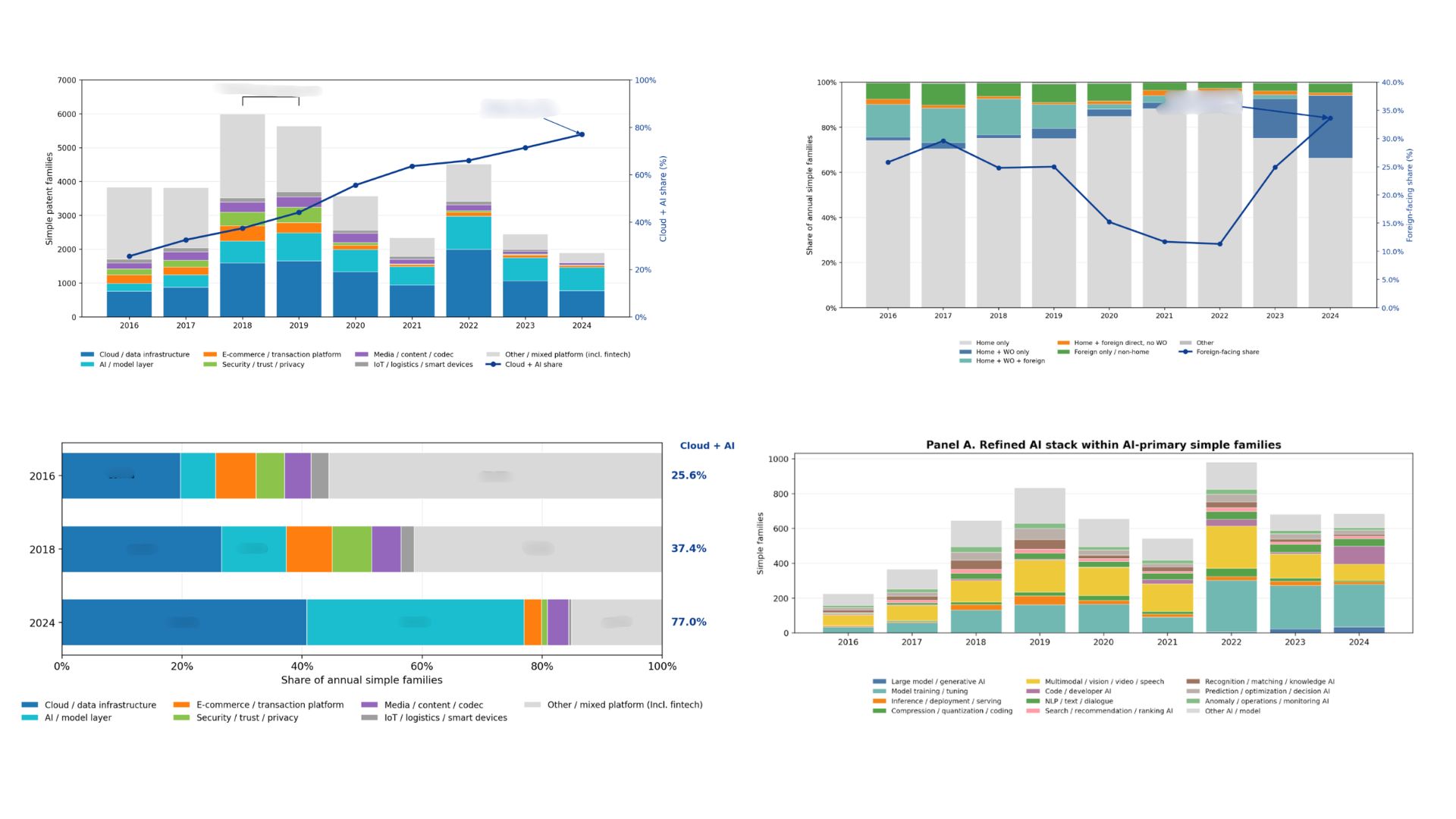
The most revealing point in Alibaba’s patent data is not where the curve rises, but where it does not. The portfolio does not peak in the current generative-AI cycle. Its strongest filing wave came earlier, when Alibaba’s patent estate was still largely built to support the machinery of a platform economy: commerce, search, payments, user interaction, service systems, and the data-processing layers behind them. What changes later is not the headline count, but the centre of gravity. By 2024, the annual mix points much more clearly toward cloud infrastructure and AI model capability.
That makes Alibaba a different kind of patent story from a sudden AI boom — and from the volume-breakout pattern seen in BYD’s patent map (May 13, 2026 ip fray article), where the post-2021 patent-family surge tracked a visible industrial scale-up.
Alibaba’s data reads more like estate renovation: a deep platform portfolio being refitted around cloud-native AI infrastructure. The technology map shows the shift from broad platform applications to cloud, data infrastructure, and model-layer filings. The AI layer shows that large models are only the visible crest, while training, multimodal processing, code tasks, and cloud overlap form the deeper structure. The foreign route is equally selective: more PCT optionality than broad nationalization, a U.S. path that looks legacy-heavy under currently visible data, and technology layers that internationalize unevenly. Alibaba’s patent map, in short, is becoming less about the platform it built first, and more about the infrastructure it is positioning for AI-driven growth, cloud expansion, and the next layer of digital services.
To Read The Full Story
Continue reading your article with a Membership