
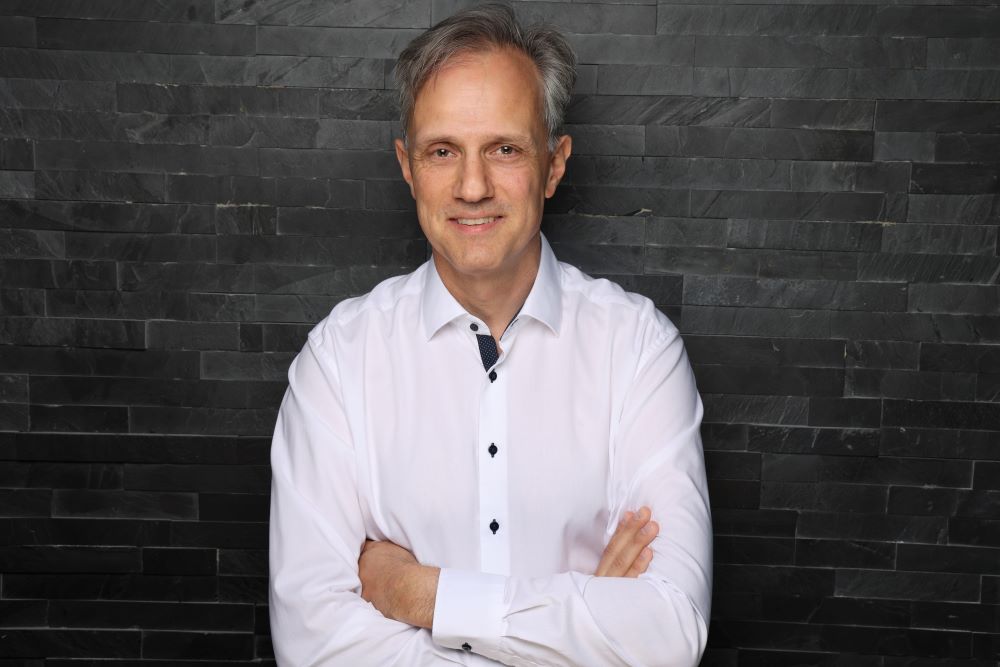
Last month, Dr. Jörg Thomaier, who just entered his 28th year at global pharma giant Bayer AG (January 9, 2025 ip fray article), stepped down from his role as head of IP. Now at the helm of the team is Dorian Immler, who has been at the German pharmaceutical company since 1999, serving on the research team, as well as chief patent counsel and head of the pharma, consumer health and animal health patents teams, in that time.
The reshuffle came as Bayer recently initiated a major restructuring, with the IP team shrinking from 190 to 160 people, of which around 90 are qualified patent attorneys. But as Dr. Thomaier clarifies in an interview with ip fray, the restructuring also brought some early retirement opportunities for many employees, which he was very happy to take.
Dr. Thomaier notes that he is “super confident” that his replacement will have the support of the whole company (budget-wise, etc) and that he is “certainly” the right person to take the reins. ip fray also sat down with Mr. Immler in a parallel interview to discuss his career to date, Bayer’s ongoing enforcement campaigns, and where he plans to take the IP department.
The next chapter
Dr. Thomaier and his wife had long wanted an early retirement. He refers to the life trap concept:
“When you’re young, you have no money but time. In the middle period, you have money but no time. When you retire, you (usually) have money and time, but the question is: are you still capable of doing what you want? You’re not getting healthier as you get older.”
After his father passed in January, Dr. Thomaier took that as a sign to talk to Bayer and finalize his agreement.
But he doesn’t plan to give up on IP completely. Once the year is up, he plans to find freelance work, whether that is participating in IP strategy seminars, teaching, or consultation work for law firms or private equity firms.
And, looking to the future of Bayer, he says he leaves the IP department in a very good position:
“When I announced my departure, I got a lot of positive feedback – they trust me, and I know that even if Bayer is going through tough times now, it’ll come out fine on the other side.”
He says the department has successfully been able to streamline IP, and that, to keep this going between different divisions, the company will be piloting some processes that he is optimistic Mr. Immler will be able to drive forward. “He is super technical and digital-oriented, so he is certainly the right person,” he says. Those processes will also take a lot of energy, which a “younger” IP head may be more suited to make, Dr. Thomaier adds.
“I want to realize the next chapter of my life, where I am not only rich in time and money, but I also have the capability to live my life.”
Mr. Immler echoes Dr. Thomaier’s views, confident in himself and the function that his predecessor has left behind. “The company is in a difficult spot”, he says, ‘but we will be able to manage all the upcoming change.”
The new head has spent most of his career at Bayer. He highlights three major milestones in the last 26 years:
- The decision to switch from research to patents: this was life-changing. I never regretted it for a single moment. It allowed me to take my scientific background and combine it with legal and business aspects. That’s what makes it so special: you are truly interdisciplinary in what you do. I talk to researchers today and commercial people tomorrow. The switch mainly occurred after I realized that in research I was far away from what the company is really doing – and seeing colleagues in patents were having a lot of fun.
- The Nexavar compulsory licensing case in India: Bayer was confronted with a request for compulsory licensing in India for one of our oncology products (Nexavar). This is when I learned how political IP is, especially in pharma. There are some activists who blame the IP system for all the challenges that we have in healthcare, whereas I see IP as an enabler of life science and healthcare innovation. That was the start of my IP and advocacy role. Innovation is highly risky and expensive, so how do you keep people investing? Because you have an incentive to do so. And that is the IP system. There are challenges, and we as a society should try to solve them. But weakening the IP system is not a way to get there.
- Divesting Bayer’s Animal Health business: a very educational experience (October 30, 2019 Bayer press release).
Living up to expectations
Mr. Immler plans to simulate a lot of what Dr. Thomaier did in being a successful leader, including putting his people first. “It’s about translating what the organisation needs into something people can connect to and people are willing to invest in – something they feel they are contributing to that is worth it, and giving people the feeling that they are appreciated for doing exactly that,” he says.
People are “our most important resource” – but they are not just a commodity that you buy, he notes.
The new head has two main goals:
- Making sure the IP function lives up to company expectations: Bayer is undergoing significant changes under a so-called dynamic shared ownership, which their CEO is introducing. Mr. Immler wants to keep results coming regardless of those changes.
- Extracting value from the tech revolution: with AI strongly pushing into the legal and IP fields, Mr. Immler wants to find out what that means for Bayer and where it can draw value in terms of these technologies. Bayer wants to not only stay on top of that, but also be at the leading edge of that.
But with big goals come obstacles, the biggest one being a lack of resources. Bayer is currently launching new products all the time, but these take time to make money, and a company can never know quite how successful they will be. “We have to make sure we use our limited resources to the best – I am optimistic we will get through it,” Mr. Immler says.
Litigation in Europe and beyond
Bayer is currently very actively defending its Xarelto product (for the treatment of multiple cardiovascular diseases) throughout Europe, with a triple-digit number of proceedings across the continent. Earlier this week, after being granted permanent injunctions by the Munich I Regional Court against generics makers Stada and Aliud Pharma in February, Germany’s Federal Patent Court revoked a crucial patent for Xarelto, potentially clearing the way for generics drugs to enter the German market.
This, Mr. Immler notes, really underpins how complex patent litigation in Europe is becoming – because it is so “fragmented” on the national level. The company is yet to assert patents in the Unified Patent Court, although the IP head says he looks forward to a time when they do. Bayer also recently settled a dispute with a rival in the crop science field (July 4, 2025 Farm Online article).
Outside of Europe, Bayer has seen an increased number of disputes in China, especially now with the introduction of its patent linkage system for pharma, in the U.S., India, and across Latin America.
To ensure that they are as successful as possible in these disputes, Mr. Immler emphasizes the importance of having internal team members on the ground in the countries where these disputes are being fought. The company has had people on the ground in China for over 25 years, and its success rates are directly linked to that team, he says. The same is true of Latin America, he adds:
“We as multi-national companies have looked at Europe and the U.S., and imposed our approaches on others, but that’s over. Other countries are now trying to adapt our approaches to their own needs.”