
Context:
- It’s been a little less than a year since ACT | The App Association, which claims to represent small comp,anies while Big Tech pays the piper and picks the tune, withdrew its application to join the European Telecommunications Standards Institute (ETSI) (December 2, 2025 ip fray article). Meanwhile, ACT has renamed itself and returned to its older name of Association for Competitive Technology while keeping the acronym,.
- Years earlier, an investigate report by Bloomberg had already exposed ACT as then being essentially an Apple front. ACT has since broadened its base, but not by receiving funding from small companies: it brought in Amazon and Google.
- ACT’s advocacy agenda is almost exclusively about the devaluation of standard-essential patents (SEPs) and the perpetuation of the mobile app store duopoly. The first is of zero relevance to app makers (especially small app makers), and the second goes directly against their interests. Anyone with a modicum of knowledge of digital innovation policy, common sense, and a minimum ethical standard would draw the appropriate conclusions from such simple facts.
- That said, ACT continues to find regulators and policy makers who knowingly leverage astroturfing, are uninformed (sometimes gullible), or who lack the self-respect and commitment to integrity to flatly reject such means of influencing policy and regulatory decisions. Marion Walsmann MEP is a special case because she is a former astroturfer herself: her political career was built on “democratic” window-dressing under a dictatorship.
- Most recently, ACT has written to the Korea Fair Trade Commission (KFTC) in support of TCL against InterDigital (for the regulatory context, see the November 11, 2026 ip fray interview with InterDigital’s Chief Legal Officer Josh Schmidt). That is part of its Big Tech-funded SEP devaluation campaign.
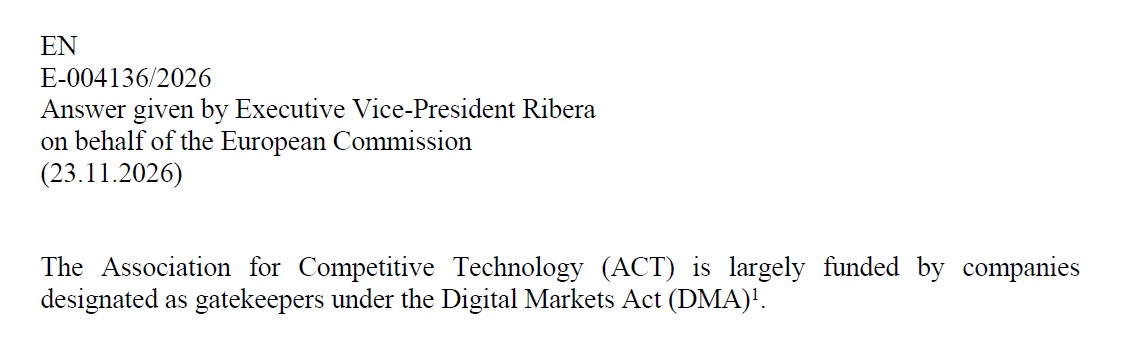
What’s new: Now, at long last, the European Commission (EC) has officially acknowledged that Brussels knows full well what ACT is all about. On Monday (November 23, 2026), the EC’s Executive Vice-President Teresa Ribera replied to a written question by Member of the European Parliament (MEP) Andreas Schwab that ACT “is largely funded by companies designated as gatekeepers under the Digital Markets Act (DMA)”. Only very large tech companies meet the quantitative thresholds for that designation. The EC obviously means Apple, Google, and Amazon.
Direct impact: The specific context of the letter is not SEP-related. It’s about platform gatekeepers.
Wider ramifications: The EC has handed those facing ACT’s astroturfing a silver bullet to point to. You can find a copy of the official letter below.
Here’s the EC’s November 23, 2026 answer to Andreas Schwab MEP:
The EC shamefully allowed ACT to speak at various events on behalf of “small app developers” or “small IoT device makers” instead of allocating the same speaking time to those who are also actually funded by those they claim to represent (on whatever side of whatever debate).
The EC itself is no stranger to astroturfing and similar methods: it sometimes uses European taxpayers’ money to fund “NGO” campaigns against some of its own member states and companies, Any governmental body that funds an NGO is by definition engaging in astroturfing because governmental funding belies the N in NGO (non-governmental organization). But that is another topic.
ACT’s explanation that Big Tech funding allows it to effectively represent the interests of small companies is irreconcilable with basic economic logic and psychology. It’s like an Iran-funded group of Jewish Israelis advocated “from the river to the sea” policies (going against its purported stakeholders such as in the app store context) and the creation of more Shia-specific courts in Saudi Arabia (a topic of zero practical relevance to its purported constituents).
Follow the money.